Minimizing Gaps in Minimally Invasive Cardiac Surgery – Redefining the Boundaries of Complex Heart Surgery at B. P. Poddar Hospital
13 October, 2026
For decades, open-heart surgery has remained the conventional approach to treating complex cardiac conditions. However, advancements in surgical techniques, medical technology and clinical expertise have progressively transformed the landscape of cardiac surgery. Procedures that once required opening the chest through a large incision can now, in selected cases, be performed through significantly smaller incisions.
Minimally Invasive
Cardiac Surgery (MICS) represents one of the most significant developments in this direction, offering patients the possibility of complex cardiac interventions with reduced surgical trauma, less postoperative discomfort and faster recovery.
Yet, despite its advantages, MICS presents considerable technical challenges, particularly in patients with advanced coronary artery disease or multiple cardiac conditions.
At B. P. Poddar Hospital, New Alipore, Kolkata, nearly a decade of experience, continuous innovation and specialised surgical expertise have helped progressively overcome several of these conventional limitations, expanding the possibilities of minimally invasive cardiac surgery.
Understanding Minimally Invasive Cardiac Surgery
Minimally Invasive Cardiac Surgery (MICS) refers to cardiac surgical procedures performed through smaller incisions instead of the conventional approach of opening the breastbone, or sternum, to access the heart.
Depending on the condition and the procedure, surgeons access the heart through a small incision between the ribs or another limited surgical opening, using specialised instruments and advanced surgical techniques.
MICS may be considered for various cardiac conditions, including:
- Coronary Artery Bypass Grafting (CABG)
- Aortic Valve Replacement (AVR)
- Mitral Valve Repair or Replacement (MVR)
- Double Valve Replacement (DVR)
- Selected combined bypass and valve procedures
- Selected congenital heart defects
However, whether a patient is suitable for MICS depends on several factors, including the complexity of the cardiac condition, anatomical considerations, associated medical conditions and the expertise of the surgical team.
Conventional Open-Heart Surgery vs MICS: Understanding the Difference
Traditional open-heart surgery generally involves a median sternotomy, where the breastbone is divided to provide surgeons with direct and extensive access to the heart.
This approach offers excellent visibility and greater freedom to perform complex surgical manoeuvres, making it particularly valuable in advanced or complicated cardiac conditions.
However, the procedure also involves considerable surgical trauma to the chest wall and breastbone. Patients generally experience greater postoperative discomfort, require a longer period for sternal healing and may face an extended recovery period before resuming normal activities.
MICS offers an alternative approach by reducing the extent of surgical access without necessarily compromising the intended cardiac correction.
Since many MICS procedures avoid dividing the breastbone, patients may benefit from:
- Smaller surgical incisions and reduced tissue trauma
- Less postoperative pain and blood loss
- Lower risk of certain wound-related complications
- Shorter hospitalisation in selected cases
- Faster mobilisation and return to routine activities
- Smaller postoperative scars
Importantly, these advantages depend on the type of surgery, the patient’s clinical condition and the surgical approach adopted.
Why Is MICS Not Suitable for Every Patient?
Despite its considerable advantages, minimally invasive cardiac surgery is technically more demanding than conventional open-heart surgery.
In traditional surgery, the surgeon has extensive access to the heart, making it comparatively easier to visualise and operate on different cardiac structures.
MICS, however, involves working through a restricted surgical opening, where visibility, instrument movement and access to certain anatomical locations are considerably limited. These restrictions become particularly significant in complex cardiac procedures.
For instance, in patients with triple vessel coronary artery disease, all three major coronary arteries are affected by significant blockages. Performing multiple bypass grafts through a limited incision requires exceptional surgical precision, particularly when the affected vessels are located across different regions of the heart.
Similarly, patients requiring simultaneous coronary bypass and valve replacement present additional challenges because the surgeon must address multiple cardiac structures through the same restricted access.
Other factors that may limit the feasibility of MICS include severe coronary calcification, difficult vessel anatomy, certain chest wall abnormalities, extensive adhesions from previous surgery, haemodynamic instability and some forms of advanced cardiac dysfunction.
Consequently, complex multivessel bypass procedures, combined cardiac surgeries and certain congenital heart operations have traditionally been considered unsuitable for minimally invasive approaches.
However, many of these limitations are relative rather than absolute. With advancements in technology, refined surgical techniques and increasing surgical expertise, procedures once considered beyond the scope of MICS are becoming feasible in carefully selected patients.
B. P. Poddar Hospital: Nearly a Decade of Advancing MICS
Recognised among the pioneering centres for minimally invasive cardiac surgery in Eastern India, B. P. Poddar Hospital has been at the forefront of developing and expanding MICS capabilities.
With almost a decade of experience, the hospital established its expertise through its signature 4-Inch Cut Heart Bypass, demonstrating that coronary bypass surgery could be performed without the conventional full sternotomy.
Over the years, continuous advancements in surgical technology, instrumentation and operative techniques have enabled the cardiac surgical team to further minimise surgical access.
Today, selected MICS procedures at B. P. Poddar Hospital are routinely performed through incisions as small as 2.5 inches.
Spearheaded by Dr. Md. Rashid Zeya Ayubi, Consultant CTVS Surgeon, the hospital’s MICS programme has progressively evolved from minimally invasive coronary bypass procedures to technically demanding multivessel and combined cardiac surgeries.
The programme encompasses complex CABG procedures, including triple vessel disease, alongside selected cases requiring coronary bypass combined with Aortic Valve Replacement (AVR), Mitral Valve Replacement (MVR) and Double Valve Replacement (DVR).
The objective is not merely to reduce incision size but to expand the range of patients who may safely benefit from minimally invasive cardiac surgery.
Advancing Coronary Bypass Surgery with RIMA–LIMA Arterial Grafting
An important area of expertise at B. P. Poddar Hospital is the use of advanced arterial grafting techniques, including RIMA–LIMA grafting, in coronary bypass surgery.
During CABG, surgeons create alternative pathways for blood to flow around blocked coronary arteries using healthy blood vessels taken from other parts of the body.
Conventionally, these grafts may include the Left Internal Mammary Artery (LIMA), the Right Internal Mammary Artery (RIMA) and segments of the Saphenous Vein, commonly harvested from the leg.
The internal mammary arteries, located along the inner chest wall, are particularly valued for their long-term durability and resistance to atherosclerotic disease.
By strategically using both the Right and Left Internal Mammary Arteries, surgeons can establish arterial bypass grafts to restore blood circulation to affected coronary territories.
In appropriately selected patients, RIMA–LIMA arterial grafting can eliminate the need for Saphenous Vein Graft (SVG) harvesting, thereby avoiding an additional incision in the leg.
Beyond reducing surgical trauma, arterial grafting offers important long-term advantages because internal mammary artery grafts generally demonstrate superior long-term patency compared with conventional vein grafts.
However, the feasibility of using exclusively arterial grafts depends on the number and location of coronary blockages, vessel suitability and individual patient requirements.
Under the surgical leadership of Dr. Rashid Zeya Ayubi, B. P. Poddar Hospital continues to incorporate advanced arterial grafting strategies as part of its evolving MICS programme.
Endoscopic SVG Harvesting: Minimising Trauma Beyond the Chest
In patients where Saphenous Vein Grafts remain necessary, B. P. Poddar Hospital also employs Endoscopic Vein Harvesting (EVH).
Traditionally, harvesting the saphenous vein involves a relatively long incision along the leg to remove the required segment of the blood vessel.
Endoscopic harvesting, however, enables surgeons to retrieve the vein through one or more small incisions using specialised instruments and camera-guided visualisation.
This technique can significantly reduce leg wound complications, postoperative discomfort and scarring compared with conventional open vein harvesting.
The integration of RIMA–LIMA arterial grafting and endoscopic SVG harvesting reflects the hospital’s broader approach towards minimising surgical trauma wherever clinically appropriate.
Breaking Conventional Barriers: Complex Multivessel MICS-CABG
One of the most significant challenges in minimally invasive coronary bypass surgery is performing multiple grafts across different coronary territories through a restricted surgical opening.
Patients with extensive triple vessel disease, particularly those requiring three or four bypass grafts, are frequently considered for conventional sternotomy because of the technical complexity involved.
At B. P. Poddar Hospital, however, the surgical team led by Dr. Rashid Zeya Ayubi has been progressively extending these boundaries.
Among several complex procedures performed at the hospital, a particularly noteworthy case involved a 45-year-old patient with advanced triple vessel coronary artery disease, including significant involvement of the Left Anterior Descending (LAD) artery.
The severity and distribution of the blockages would ordinarily favour
conventional open-heart bypass surgery.
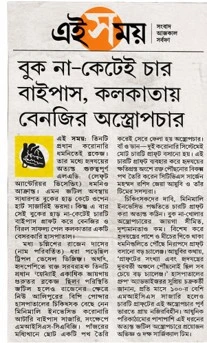
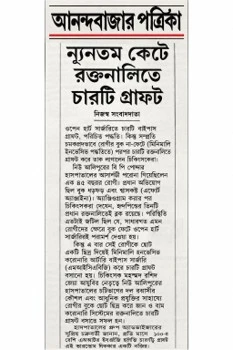
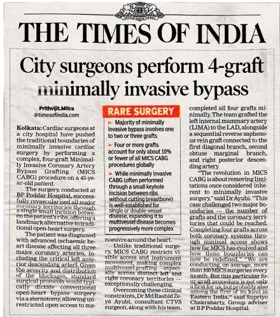
However, Dr. Rashid Zeya Ayubi and his team successfully performed a rare four-graft Minimally Invasive Coronary Artery Bypass Grafting (MICS-CABG) procedure through a single limited incision between the ribs.
The procedure involved grafting the LIMA to the LAD, along with sequential saphenous vein grafting to three additional coronary targets, achieving revascularisation across both left and right coronary territories.
The case, reported by The Times of India, demonstrated how specialised expertise can overcome two major limitations traditionally associated with MICS: the number of grafts that can be performed and the anatomical territories that can be accessed.
Rather than representing an isolated achievement, this procedure reflects the hospital’s expanding experience in increasingly complex minimally invasive cardiac interventions.
Extending Surgical Expertise to Complex Congenital Heart Disease
The surgical expertise of
B. P. Poddar Hospital also extends to paediatric cardiac surgery, particularly the management of complex congenital heart defects.
Congenital
heart diseases present a distinct set of surgical challenges, as structural abnormalities in the heart may require intricate reconstruction and precise corrective interventions, sometimes within the first few days of life.
The hospital’s paediatric cardiac surgical programme, led by Dr. Rashid Zeya Ayubi, encompasses specialised management of congenital cardiac conditions, including minimally invasive approaches in appropriately selected cases.
A notable demonstration of the team’s expertise involved a 12-day-old newborn suffering from obstructed Infracardiac Total Anomalous Pulmonary Venous Connection (TAPVC), a rare and life-threatening congenital heart defect.
In this condition, the pulmonary veins carrying oxygenated blood from the lungs connect abnormally to the systemic venous circulation instead of the left atrium.
The resulting obstruction can cause severe respiratory distress and rapid deterioration, making emergency surgical correction essential.
Dr. Rashid Zeya Ayubi and his team successfully performed a complex six-hour corrective cardiac surgery, following which the newborn recovered under specialised postoperative care and was subsequently discharged.
The case, also reported by The Times of India, highlights the hospital’s ability to undertake technically demanding cardiac interventions across an exceptionally broad age spectrum.
While the surgical approach must always be determined by the patient’s anatomy and clinical condition, such expertise provides an important foundation for advancing minimally invasive techniques in selected paediatric cardiac procedures.
Minimising Incisions. Expanding Possibilities.
The evolution of minimally invasive cardiac surgery is no longer defined solely by the size of the incision.
Its true significance lies in progressively overcoming anatomical and technical limitations while maintaining the safety, precision and effectiveness of complex cardiac interventions.
At B. P. Poddar Hospital, the integration of advanced surgical technologies, RIMA–LIMA arterial grafting, endoscopic vein harvesting and specialised expertise in complex coronary, valvular and congenital cardiac surgeries has helped broaden the scope of MICS.
Under the leadership of Dr. Md. Rashid Zeya Ayubi, Consultant CTVS Surgeon, the hospital continues to push the boundaries of minimally invasive cardiac surgery, making increasingly complex cardiac procedures accessible through smaller surgical incisions in appropriately selected patients.
From its signature 4-Inch Cut Heart Bypass to advanced procedures performed through incisions as small as 2.5 inches, the hospital’s continuing journey reflects an important shift in modern cardiac surgery.
Because the future of minimally invasive cardiac surgery is not just about making smaller incisions. It is about minimising limitations and expanding possibilities.
For expert consultation regarding Minimally Invasive Cardiac Surgery, Coronary Artery Bypass Grafting, Complex Valve Surgery and Congenital Heart Disease, contact the
Department of Cardiothoracic and Vascular Surgery (CTVS), B. P. Poddar Hospital, New Alipore, Kolkata.
Featured Cases in the News (Digital Media)
- Rare Four-Graft Minimally Invasive CABG at B. P. Poddar Hospital- Surgery by Dr. Md. Rashid Zeya Ayubi
The Times of India |
Read the published report
- Rare Six-Hour Cardiac Surgery on a 12-Day-Old Newborn- Surgery by Dr. Md. Rashid Zeya Ayubi
The Times of India |
Read the published report
Featured Cases in the News (Print Media)


 NABH Accredited Hospital