
Advancements in therapeutic endoscopy are progressively transforming the management of complex gastrointestinal and hepatobiliary conditions. Procedures that traditionally required extensive surgical reconstruction can now, in carefully selected cases, be managed through advanced minimally invasive endoscopic interventions.
One particularly challenging area involves complications following gallbladder surgery, especially injuries affecting the bile duct. While most gallbladder removal procedures are performed safely, an accidental injury to the biliary system can result in serious complications requiring urgent medical intervention.
Complete severance of the common bile duct, particularly when accompanied by damage to adjacent gastrointestinal structures, presents an exceptionally complex clinical situation.
At B. P. Poddar Hospital, New Alipore, Kolkata, advanced therapeutic endoscopy has helped expand treatment possibilities for such complications. A recent case involving a completely severed bile duct and a perforated duodenum demonstrated how specialised endoscopic expertise could help avoid major reconstructive surgery.
Understanding Bile Duct Injuries Following Gallbladder Surgery
The common bile duct (CBD) is an important part of the biliary system, responsible for transporting bile into the small intestine, where it assists in the digestion of fats.
During gallbladder removal, medically known as cholecystectomy, the bile duct can occasionally sustain an injury due to anatomical variations, inflammation or technical difficulties encountered during surgery.
The severity of such injuries can vary considerably. Minor bile leaks may be managed through conventional endoscopic procedures. However, complete transection, where the bile duct becomes entirely severed, is significantly more challenging.
When this occurs, bile may leak into the abdominal cavity instead of flowing normally into the intestine. This can cause severe abdominal pain, distension, infection and potentially life-threatening complications if not addressed promptly.
Why Complete Bile Duct Transection Traditionally Requires Major Surgery
For patients with complete bile duct disruption, conventional endoscopic treatment may be unsuccessful because the continuity between the two ends of the duct has been lost.
In such situations, patients frequently require a major reconstructive operation known as hepaticojejunostomy.
This procedure involves surgically connecting the remaining bile duct to a portion of the small intestine, thereby creating an alternative pathway for bile drainage.
Although hepaticojejunostomy remains an established treatment for significant bile duct injuries, it is a complex operation requiring specialised surgical expertise.
Patients may face considerable operative risks, prolonged hospitalisation, extended recovery periods and substantial treatment-related expenditure.
Consequently, identifying safe and effective alternatives to major reconstruction can be particularly valuable in appropriately selected patients.
Case Study: A Severed Bile Duct and a Perforated Duodenum
A particularly challenging case recently presented at B. P. Poddar Hospital involved a 30-year-old female patient who had undergone gallbladder surgery at another healthcare facility.
Although she initially returned home following the procedure, she subsequently developed severe abdominal pain and distension, necessitating hospitalisation.
Further investigations revealed a serious complication: her common bile duct had been completely severed, resulting in extensive leakage and accumulation of bile within the abdominal cavity.
An earlier attempt at Endoscopic Retrograde Cholangiopancreatography (ERCP) had been unsuccessful because the complete disruption prevented access to the proximal biliary system.
However, the clinical challenge extended beyond the bile duct injury.
An abdominal drain inserted during her previous treatment had perforated the duodenum, the first part of the small intestine, and become embedded within it.
The combination of a completely severed bile duct, a perforated duodenum and an earlier failed ERCP made the possibility of avoiding major reconstructive surgery appear increasingly remote.
Explaining the complexity, Dr. Shiv Ratan Pathak, Consultant Gastroenterologist at B. P. Poddar Hospital, said:
A complete disruption of the bile duct is among the most challenging complications of gallbladder surgery. Such patients generally require a major reconstructive operation called hepaticojejunostomy, where the bile duct is surgically connected to the small intestine. Apart from the associated surgical risks and prolonged hospitalisation, the procedure can impose a considerable financial burden on the patient and family.
Dr. Shiv Ratan Pathak, Consultant Gastroenterologist, B. P. Poddar Hospital
Despite these challenges, Dr. Pathak and his team adopted an advanced therapeutic endoscopic approach to address both complications without resorting to major reconstructive surgery.
Advanced Therapeutic Endoscopy: Restoring Bile Duct Continuity
Endoscopic Retrograde Cholangiopancreatography (ERCP) is a specialised procedure that combines endoscopy with imaging techniques to diagnose and treat conditions affecting the bile ducts and pancreatic ducts.
While ERCP is commonly used for removing bile duct stones, relieving biliary obstruction and managing certain bile leaks, treating a completely severed bile duct is considerably more challenging.
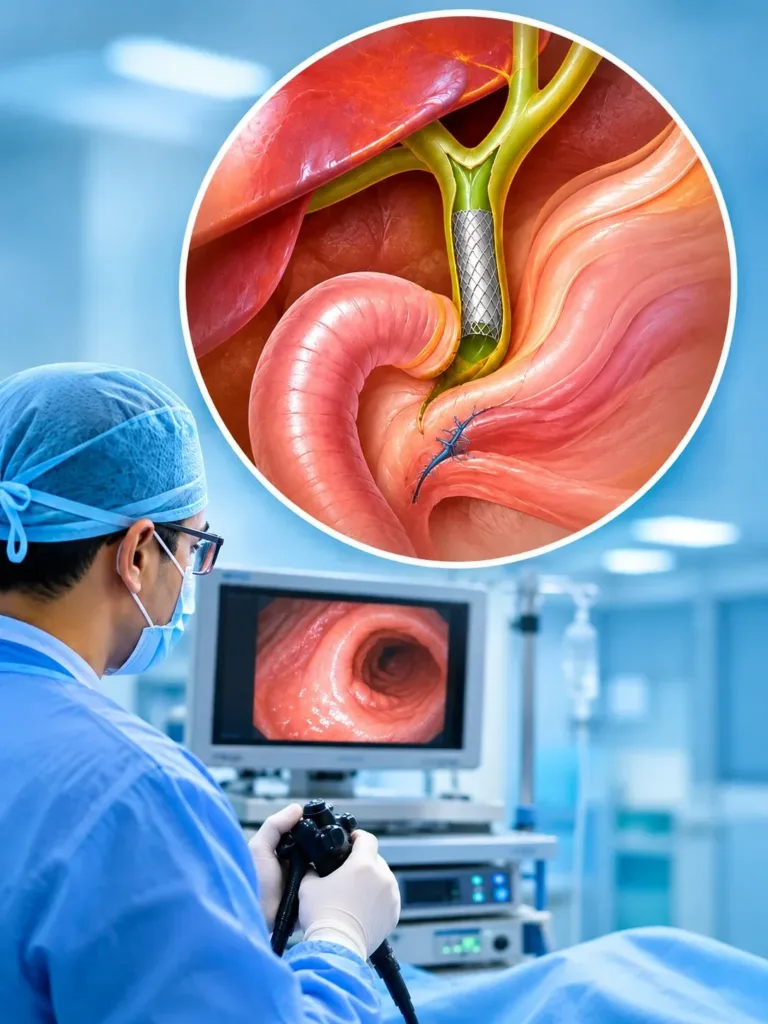
In this case, the medical team successfully bridged the two disconnected ends of the bile duct through ERCP.
A fully covered self-expanding metal stent was subsequently placed across the disrupted segment to establish a pathway for bile drainage.
The team also utilised cholangioscopy, an advanced technique that enables direct visualisation of the interior of the bile ducts, to confirm the connection.
The additional complication involving the perforated duodenum was also successfully managed through an endoscopic approach.
Describing the intervention, Dr. Pathak explained:
Despite the complete disruption, we successfully bridged the two ends of the bile duct through ERCP and placed a fully covered self-expanding metal stent to restore continuity. Using cholangioscopy, we could directly visualise and confirm the connection. The additional challenge was the perforated duodenum, which we also managed endoscopically, avoiding the need for another major operation.
Dr. Shiv Ratan Pathak
A Complex Intervention, A Remarkably Short Hospital Stay
The successful endoscopic intervention helped the patient avoid the major reconstructive surgery that would otherwise have been considered for her condition.
Remarkably, she was discharged just one day after the successful intervention.
The outcome was particularly significant considering the severity of the biliary injury, the additional duodenal perforation and the unsuccessful endoscopic attempt undertaken earlier.
While continued clinical follow-up remains important following complex bile duct injuries and stent placement, the immediate outcome demonstrated the potential benefits of advanced therapeutic endoscopy in selected patients.
Expanding the Boundaries of Minimally Invasive Gastrointestinal Care
The management of complex postoperative gastrointestinal complications is evolving with advancements in endoscopic technology, specialised instrumentation and therapeutic expertise.
Techniques such as advanced ERCP, cholangioscopy and biliary stenting are creating additional treatment possibilities for patients who might otherwise require extensive surgical interventions.
However, complete bile duct transection remains a serious injury, and endoscopic reconstruction is not suitable or technically feasible in every case. The most appropriate treatment must be determined according to the nature of the injury, the patient’s clinical condition and the expertise available.
At B. P. Poddar Hospital, the successful management of this complex case reflects the growing role of advanced therapeutic endoscopy in addressing challenging gastrointestinal and hepatobiliary conditions.
More importantly, it highlights a significant shift in modern gastrointestinal care: moving beyond conventional treatment limitations to explore less invasive solutions wherever clinically appropriate.
The advancement of therapeutic endoscopy is not merely about avoiding surgery. It is about expanding treatment possibilities while prioritising patient safety, clinical outcomes and recovery.
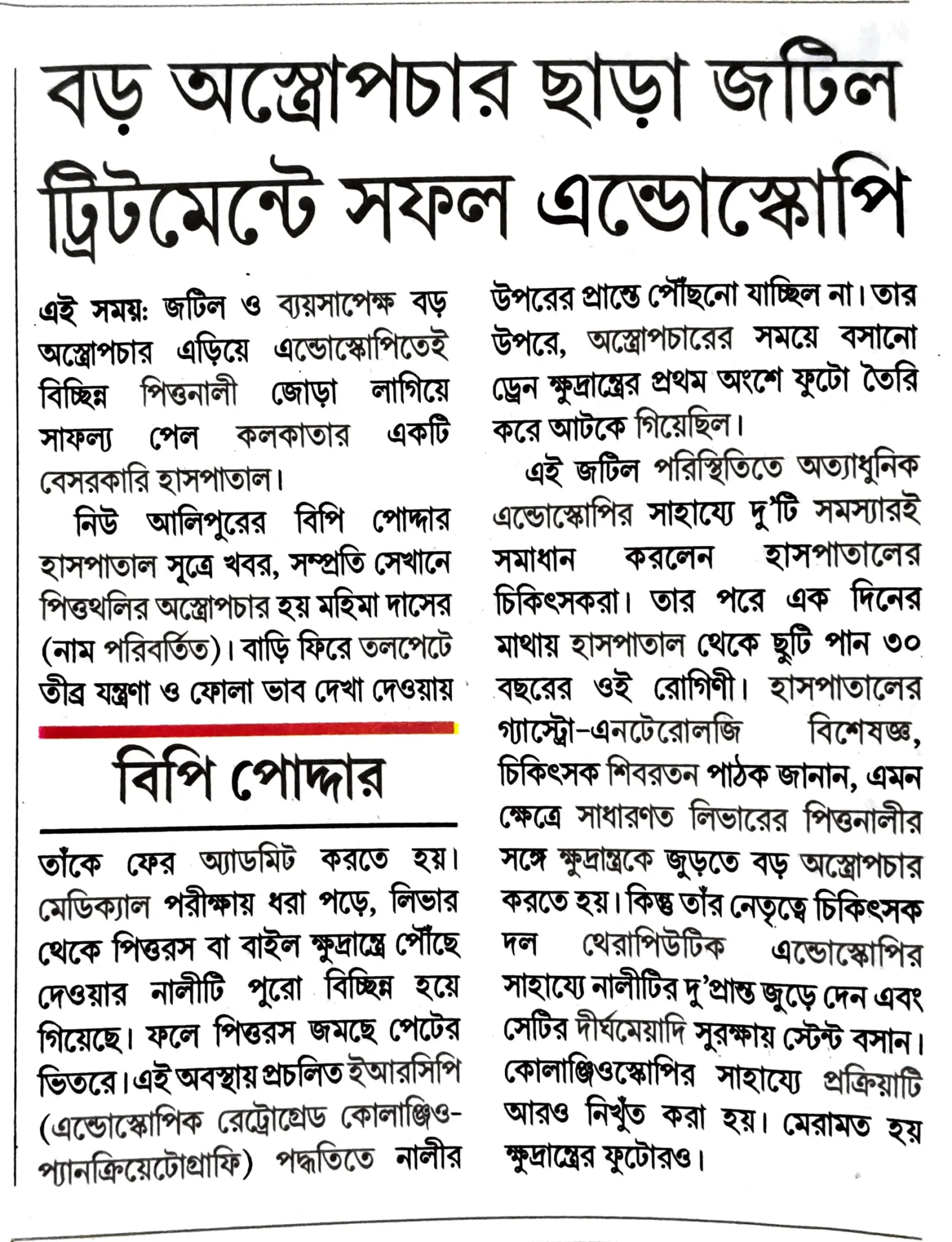
Featured Article in the Print Media