
Reviewed by
Dr. Jyotirup Goswami
Sr. Consultant Radiation Oncologist
Indigestion or a feeling of fullness after a meal may seem like everyday gastric trouble. Often, that is exactly what it is. However, when such symptoms persist, worsen or occur alongside unexplained weight loss, they deserve medical attention.
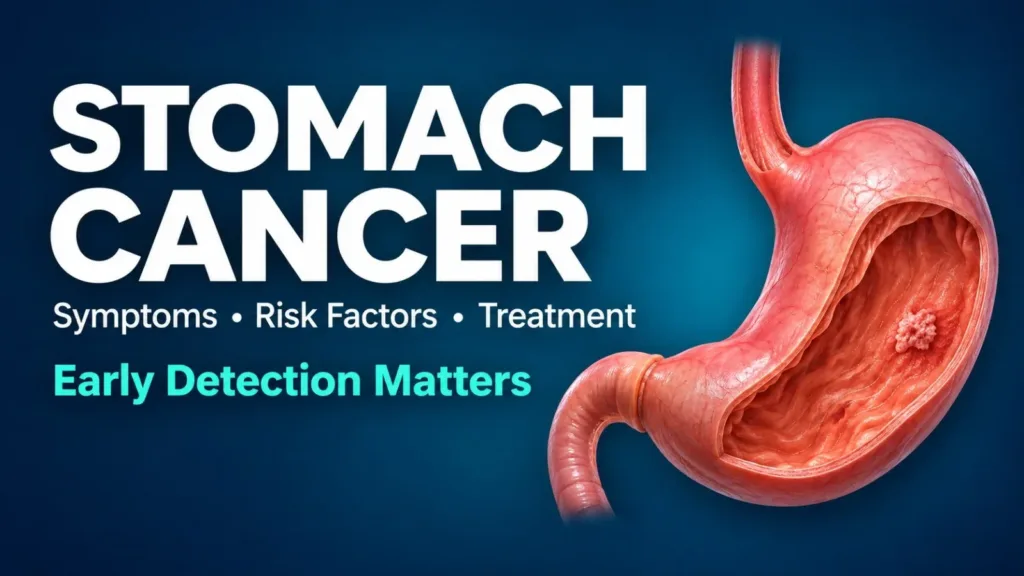
Stomach cancer, also known as gastric cancer, can be difficult to recognise in its early stages because symptoms are often subtle. Understanding the warning signs, risk factors and available investigations can help people seek timely care.
Stomach cancer statistics
Stomach cancer is the fifth most commonly diagnosed cancer worldwide. In 2024, an estimated 9.8 lakh new cases were diagnosed globally, including approximately 68,548 in India. It is also one of the leading causes of cancer-related deaths worldwide.
Understanding stomach cancer
Stomach cancer develops when abnormal cells in the stomach begin to grow uncontrollably. Most stomach cancers begin in the glandular cells lining the stomach and are known as adenocarcinomas.
As the disease progresses, it may grow into deeper layers of the stomach wall, involve nearby lymph nodes and, in advanced cases, spread to distant organs. The extent of disease at diagnosis plays a major role in determining treatment and prognosis.
Warning signs and symptoms
Early stomach cancer may cause no noticeable symptoms. When symptoms do occur, they can resemble common digestive problems. They include:
Persistent indigestion, acidity or upper abdominal discomfort
Feeling unusually full after eating a small amount
Loss of appetite or unexplained weight loss
Persistent nausea or vomiting
Bloating after meals
Difficulty swallowing
Unexplained tiredness or weakness, sometimes due to anaemia
Blood in vomit or black, tarry stools
These symptoms can have many causes and do not necessarily indicate cancer. However, persistent or worsening symptoms should be assessed by a doctor, particularly when accompanied by weight loss, vomiting or difficulty swallowing. Vomiting blood or passing black, tarry stools requires urgent medical attention at an emergency department.
A consultation at the Gastro Clinic can help determine whether further evaluation is needed.
Stomach cancer risk factors
Stomach cancer does not usually have a single identifiable cause. Several factors can increase a person’s risk:
1. Chronic H. pylori infection
Helicobacter pylori (H. pylori) is a bacterium that can cause long-standing inflammation of the stomach lining. Over time, this can lead to changes that increase the risk of some stomach cancers. Most people with H. pylori infection do not develop cancer, but appropriate testing and treatment, when advised, are important.
2. Smoking and alcohol
Smoking increases the risk of stomach cancer, while heavy alcohol consumption is also associated with an increased risk. Stopping tobacco use and limiting alcohol can help reduce cancer risk.
3. Dietary habits
A diet high in heavily salted, smoked or preserved foods is associated with an increased risk. A balanced diet with adequate fruits and vegetables supports overall health.
4. Long-standing stomach conditions
Certain conditions, including chronic atrophic gastritis, intestinal metaplasia and pernicious anaemia, can increase risk. People with these conditions should discuss appropriate follow-up with their doctor.
5. Family history and inherited factors
Having a close relative with stomach cancer increases risk. Some inherited conditions, including hereditary diffuse gastric cancer and Lynch syndrome, can also make a person more vulnerable. A specialist may recommend further assessment or genetic counselling when appropriate.
Diagnosing stomach cancer
A doctor considers symptoms, medical history and examination findings before recommending tests. The investigations may include:
Upper gastrointestinal endoscopy: During an upper GI endoscopy or gastroscopy, a thin, flexible tube with a camera is passed through the mouth to examine the oesophagus, stomach and upper part of the small intestine.
Biopsy and histopathology: If an abnormal area is found, a small tissue sample may be taken during endoscopy. Examination by a pathology laboratory is used to confirm whether cancer is present.
Endoscopic ultrasound: In selected patients, endoscopic ultrasound helps assess how deeply a tumour has grown and whether nearby lymph nodes are involved.
Imaging: CT scans and other radiology investigations help assess the extent of disease. A PET-CT scan may be recommended in selected cases; it is not necessary for every patient.
Blood tests: Blood tests may help identify anaemia and assess overall health, but they cannot confirm stomach cancer on their own. Depending on the situation, doctors may also advise additional investigations to determine the stage of the disease.
B. P. Poddar Hospital’s Gastroenterology Department and gastroenterology diagnostic services provide evaluation and endoscopic investigations for digestive conditions.
Why early detection matters
When stomach cancer is detected before it has spread extensively, treatment is more likely to be given with curative intent. For carefully selected patients with very early tumours, five-year survival can exceed 90% after appropriate treatment. This figure applies to selected groups and should not be interpreted as the outcome for every patient with early or localised disease.
The aim is to identify suspicious changes as early as possible. Persistent symptoms should not be repeatedly dismissed as ordinary acidity without medical evaluation.
Stomach cancer stages and survival
There is no single survival period for stomach cancer. Prognosis depends on the extent of disease at diagnosis, the cancer’s characteristics, overall health and response to treatment.
For perspective, the following are five-year relative survival estimates from United States population data for people diagnosed between 2016 and 2022. They compare survival among people with stomach cancer with survival in a similar general population:
| Extent of disease at diagnosis | Five-year relative survival |
|---|---|
| Localised: confined to the stomach | 78.1% |
| Regional: spread to nearby tissues or lymph nodes | 39.0% |
| Distant: spread to distant organs | 8.1% |
These are population estimates, not individual predictions or India-specific figures. They are not cure rates, and they do not mean that survival ends after five years. Newer treatments may not be fully reflected in historical data.
In some clinical trials of first-line systemic treatments for advanced stomach or gastro-oesophageal junction cancer, median survival has been around 11 to 14 months. Results differ with the treatment, cancer biology and patients studied; an individual may live for a shorter or longer period.
Treatment options for stomach cancer
Treatment is planned according to the type and stage of cancer, biomarker results when relevant, and the patient’s overall health. Care may involve specialists from surgical oncology, medical oncology and radiation oncology, working with gastroenterologists and other specialists.
Endoscopic treatment
For carefully selected very early cancers with a low risk of lymph node spread, a tumour may be removed through an endoscope. The suitability of this approach depends on the depth, size and features of the tumour.
Surgery
Surgery may involve removing part or all of the stomach along with nearby lymph nodes. The procedure depends on the location and extent of the cancer. The cancer surgery team may include a surgical gastroenterologist.
Chemotherapy and other medicines
Chemotherapy may be given before or after surgery, or to help control advanced disease. For eligible patients, targeted therapy or immunotherapy may also be considered. Tests for tumour features such as HER2, PD-L1 and mismatch repair or microsatellite instability can help guide treatment choices where appropriate.
Radiotherapy
Radiotherapy uses focused radiation to treat cancer. It may be recommended in selected situations, including as part of a combined treatment plan or to help relieve symptoms such as bleeding or pain. It is not required for every patient.
Supportive and nutritional care
Stomach cancer and its treatment can affect appetite, digestion and body weight. A dietitian can help patients manage dietary changes, particularly after surgery. Symptom relief, pain management and emotional support can be provided alongside cancer treatment, including for advanced disease.
Prevention and early detection
Not every case can be prevented, but the following steps may help lower risk or support earlier evaluation:
Seek medical advice about testing and treatment for H. pylori when appropriate.
Avoid smoking and other tobacco use, and limit alcohol.
Reduce heavily salted, smoked and preserved foods; include a variety of fruits and vegetables.
Discuss a family history of stomach cancer or known precancerous stomach conditions with a specialist.
Do not ignore persistent or worsening digestive symptoms.
Screening refers to testing people who do not have symptoms. Routine endoscopy is not necessary for everyone. People at higher risk may benefit from an individual discussion about whether screening or follow-up endoscopy is appropriate. Endoscopy advised to investigate symptoms is a diagnostic test.
Stomach cancer care at B. P. Poddar Hospital
The Cancer Unit at B. P. Poddar Hospital brings together cancer specialists and diagnostic services to support patients through evaluation, treatment and follow-up. Patients seeking clarity about a diagnosis or treatment plan may also request a second opinion.
For specialist guidance, patients can consult and book an appointment with the appropriate specialist.
Frequently asked questions
Is stomach cancer the same as gastric cancer?
Gastric cancer is the medical term for stomach cancer.
Can a blood test detect stomach cancer?
A blood test can identify problems such as anaemia, but it cannot confirm stomach cancer. Endoscopy with a biopsy is generally used to establish the diagnosis.
Does persistent acidity mean stomach cancer?
Acidity and indigestion are common and usually have other causes. However, persistent or worsening symptoms, particularly with weight loss, vomiting or difficulty swallowing, should be evaluated by a doctor.
Can advanced stomach cancer be treated?
Although cancer that has spread to distant organs is rarely curable, treatment can help control the disease, relieve symptoms and extend life. The approach depends on the individual patient and the characteristics of the cancer.